Since 2010, the LCBM has been equipped with a suite of light scattering measurement instruments. This platform consists of a series of instruments working in concert to directly and rapidly measure the mass, size, and dispersion of biological or inorganic objects in solution with high precision. Studies on polymerization, sample homogeneity, protein-protein interactions, or the state of nanoparticles in biological environments require such instrumentation.
Principles : Proteins involved in redox processes, such as metalloproteins or anaerobic enzymes, are particularly sensitive to oxygen. Oxygen can induce structural or functional modifications, compromising their integrity and biasing biophysical analyses. Their study therefore requires strictly anaerobic conditions, which are difficult to maintain with conventional methods often limited to aerobic environments. SEC-MALLS-RI under anaerobic conditions provides an adapted solution, enabling precise characterization of these oxygen-sensitive biomolecules.
Integrated Technologies : The platform combines an 18-angle DLS/MALLS system, a high-sensitivity refractometer, and a high-resolution UHPLC (thermostated size exclusion column S200 increase), coupled with QELS for biophysical parameter analysis (hydrodynamic radius, Rh, and radius of gyration, Rg). Measurements can be performed under aerobic or anaerobic conditions (controlled nitrogen or argon atmosphere), ensuring optimal conditions for the study of oxygen-sensitive proteins.
The HELEOS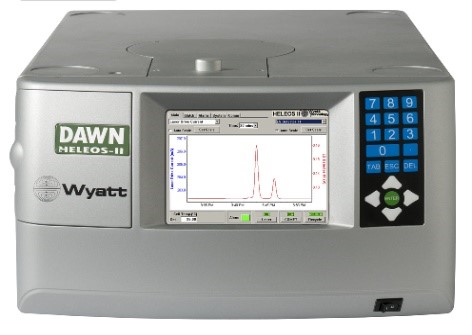
The HELEOS measures light scattering at 18 angles simultaneously, allowing for highly precise mass determination. Since light scattering is the product of mass and concentration, it works in conjunction with the refractometer or the HPLC UV spectrometer if the protein's absorption coefficient is known.
The Refractometer
The refractometer measures the change in refractive index (dn). For any protein, the dn/dc ratio is constant, allowing the refractometer to calculate the protein concentration (c) during measurement. This value is essential for accurately determining molecular weight.
Dynamic Light Scattering (DLS)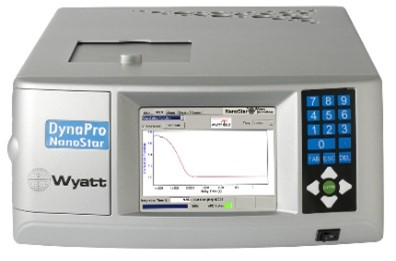
The DLS instrument can be used quickly and independently, like a simple spectrometer. It provides information on particle sizes (<500 nm), their distribution, and the dispersion level of the sample (useful in crystallography). Only a few tens of microliters are required. It can also provide an approximate estimate of mass.
Sample volume Requirements : 20-25µl
Concentration :
- Min 2mg/ml for a 60kDa protein
- Min 6mg/ml for a 10kDa protein
- Min 0.5mg/ml for a 200kDa protein
Collaborations : Institut de Biologie Structurale (IBS), Département de Chimie Moléculaire (DCM-Grenoble), Université de Bologne (Italie), le Collège de France, laboratoire BiP (Marseille)…
Platform Operation :
- Collaboration
- Service
- Provision
Recent publications :
-Insights into the role of the D-cluster in [NiFe]-CODH from Rhodospirillum rubrum . Umberto Contaldo et al. , ChemEurJ (2025).
-From two-component enzyme complex to nanobiohybrid for energy-efficient water-gas shift reaction .Pichon Thomas et al. ,Chemical Science. (2025).
-Multimodal Spectroscopic Analysis of the Fe–S Clusters of the as-Isolated Escherichia coli SufBC2D Complex . Giulia Veronesi et al., Inorganic Chemistry. (2024).
-Light-Activated Artificial CO2-Reductase: Structure and Activity . Raphaël J Labidi et al., Journal of the American Chemical Society (2024).
Contact :
For any inquiries regarding access to the platform and/or implementation of your tests, please write to the address below, specifying your needs:
julien.perard@cea.fr
Scientific Manager: Julien PERARD
Technical Manager: Roger Miras (roger.miras@cea.fr)
Note: Due to site access procedures for users, a minimum two-week notice is required.