1. Design of artificial metalloenzymes
In the field of catalysis, the search for environmentally friendly alternatives to standard homogeneous catalysts has led us to design artificial metalloenzymes based on the insertion of an inorganic complex into a protein scaffold. For many years, our team has collaborated with the BioCE group of our laboratory on the development of artificial monooxygenases. These biohybrids combine the nickel-transport protein NikA as a protein platform with a series of Ru and Fe complexes as active centers for sulfoxidation, aromatic hydroxylation, and oxychlorination reactions. Recently, the two groups successfully developed new heterogeneous catalysts using cross-linked enzyme crystal (CLEC) technology applied to “NikA/Fe complex" hybrids, achieving remarkable stability and catalytic performance. In the coming years, the CLEC technology will be extended to a range of catalytic processes for the production of new high-value-added compounds in the fields of energy and health, in accordance with the principles of green chemistry.
2. Bio-(photo)electrocatalysis devices in “Power-to-gas" applications
Today, one challenge is the development of “Power-to-gas" devices to convert CO2 into CH4 (through the Sabatier reaction: CO2 + H2 -> CH4 + 2 H2O) or syngas (through the reverse WGSR: CO2 + H2 -> CO + H2O). Our aim is to use the unique efficiency and selectivity of either purified enzymes such as CODH and hydrogenase, or microorganisms such as methanogens to develop efficient bioelectrocatalytic systems. In the field of electrocatalysis, biological systems offer the advantages to work under mild conditions, with non noble metals and at near-zero overpotential, respecting thus several principles of green chemistry.
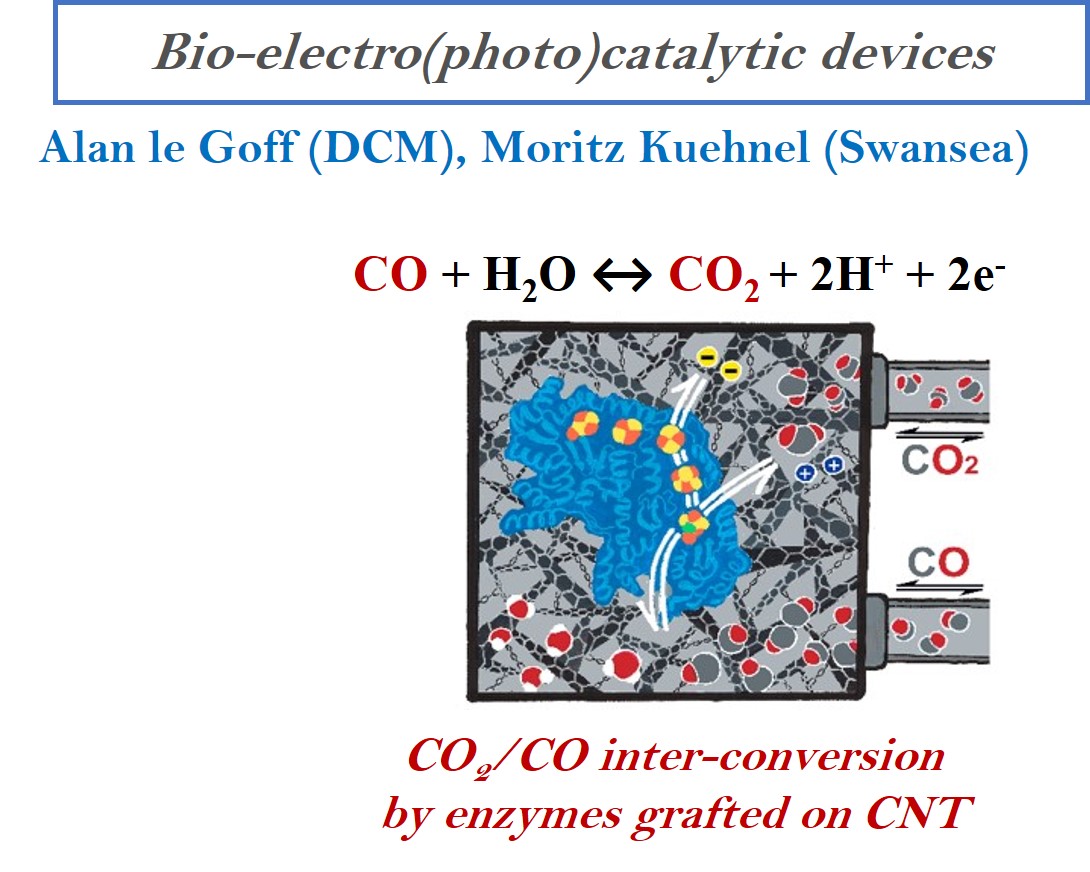
One main goal of the project is to propose a bio-electrocatalytic device to perform the reverse WGSR: Exploring the biodiversity, comparing the structures and functions of CODHs that have not been characterized before and using site directed mutagenesis to tune their properties will help identify new enzymes whose properties are better tuned for electrocatalysis. The most promising CODHs with be coupled with either hydrogenases or bio-inspired catalysts, to catalyse the reverse WGSR. These molecular nanomaterials will be integrated into (photo)-electrocatalytic reactors. In a second approach, we couple biomethanation (the production of biomethane by methanogens)and electrolysis (electromethanogenesis) to convert electricity, water and carbon dioxide into renewable methane. The design of MEC eliminates the necessity to produce H2 separately, overcoming at the same time the productivity limitations associated with low solubility and poor mass transfer of H2 in water. Main developments will be related to the design of specific electrodes and support of these electrodes to improve the mass transfer of the different species in liquid media.